* All images by Keith Skene unless otherwise stated
Edges, liminality, space and time: the corridors of power and empowerment
|
Samhain Essentials - pronounced "Sow-in" (Sow as in female pig); - Marks the start of the Celtic month of the same name; - One of four annual festivals in the Celtic year the others being Imbolk (pronounced Imolk) on 1st February, Bealtaine (pronounced Beal-tuna) on 1st May and Lughnasadh (pronounced Loonasa) on 1st August; -Marks the coming of winter and the crowning of the Goddess of winter, destruction and creation, Cailleach, who displaces Brid, the Queen of the summer; Winter was a hugely threatening season, punishing a lack of preparation with death; Samhain also had a spiritual dimension, marking the thinnest boundary between this world and the otherworld, allowing each to interact in liminal places such as woods, caves, bodies of water, mist and bogs; Liminal spaces are thresholds or portals to the otherworld; The otherworld is six months out of sync with this world, a cosmic inversion, so at Samhain, it is summer there. If a Druid could bring back summer fruit at Samhain, it would prove he had crossed over. Other similar festivals across the world: - Dia los Muertos (Day of the Dead) in Mexico; - Obon Festival in Japan, where floating lanterns placed in rivers guide the spirits back to the afterlife; - Commemorazione dei defunti in Italy, where children receive gifts from the dead; - Teng Chieh Festival (Hungry Ghost Festival) in China, where gifts are given to the dead. |
Gaelic Philosophy
Dùthchas
This fundamental philosophy of place and community emphasises people and place as one. Localism is seen as a deep, layered, atemporal thing, where there is a unity across time and where the landscape has profound meaning, with portals across to the otherworld.
Seamus Heaney, the Irish Nobel Laureate in Literature, reflects that “the soul exeeds its circumstances”.
Multiple transcendent experiences simultaneously operate through space and time, a profound more-than-human philosophy, integrating nature, human, spirit and history. Seán Ó Tuama, the Irish poet and playwright, notes that in this philosophy, “There is a sense in which place finally becomes co-extensive in the mind, not only with personal and ancestral memories, but with the whole living community culture. Community becomes place, place community".
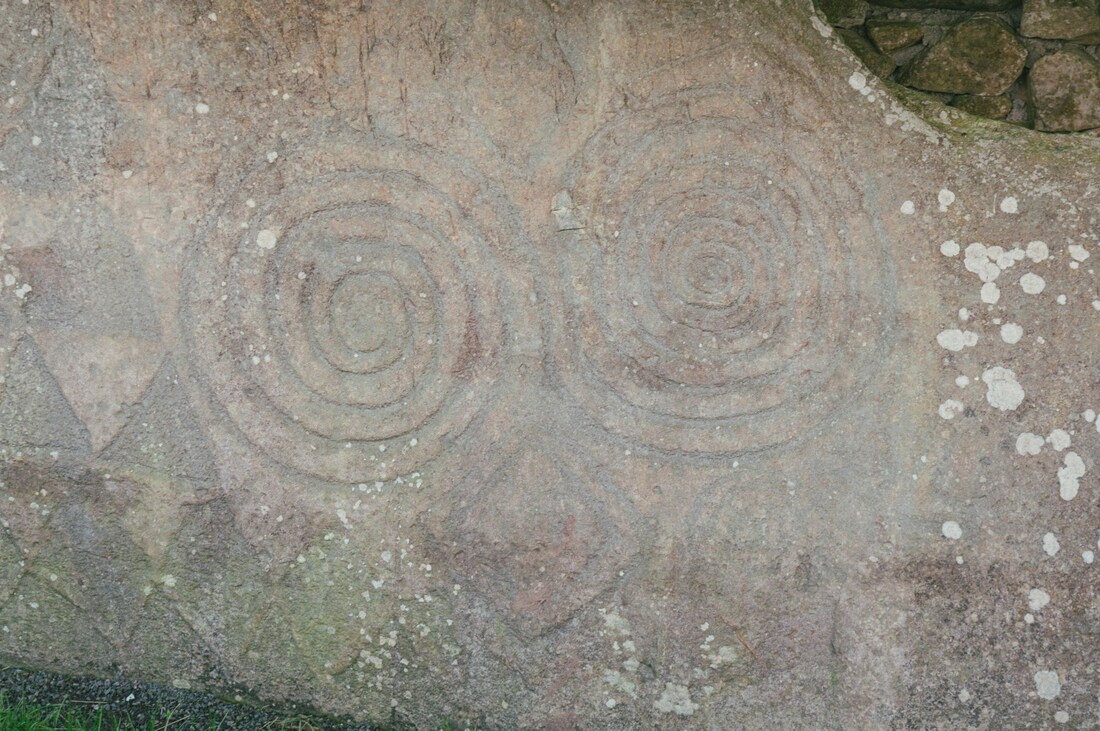
The tight relationship between Nature, human and the spiritual world was reflected in triskele symbols in Neolithic and Celtic engravings, predating the Christian holy trinity by millennia (e.g. Newgrange around 5000 BC):
Photo by Elliot Voilmy from Unsplash.
Liminality
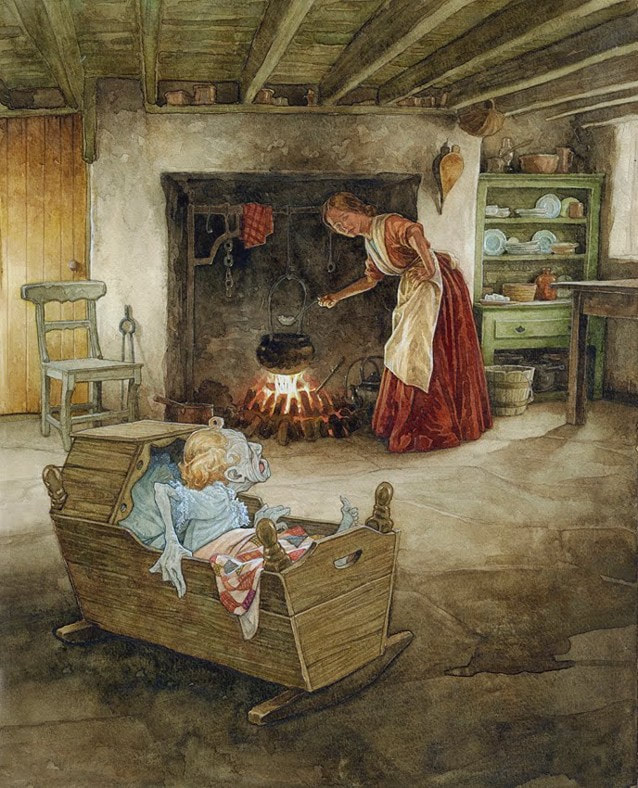
From limens meaning threshold, liminal corridors stretch across time and space, to the otherworld and ancestral wisdom. Druids and seers (Vates) could travel across to gain wisdom and insight, particularly in specific liminal landscapes such as water, caves, forests and bogs. Liminality has been explored in movies such as the Shining, where the boy on his tricycle can see the long dead twin girls at the end of a long corridor. The corridors operate in two ways - spirits can come from the otherworld, and spiritual leaders can travel to the otherworld. During Samhain, these corridors are particularly short, allowing for the best conditions for transition. Many of the traditional rituals are focused on scaring away evil spirits that may cross over. This is a time of risk as well as reward. Fairies, who can be extremely malevolent, can come across, kidnap a child or adult and replace them with an old, sick fairy that they no longer want to look after. These replacements are called changelings. Such was the fear of these fairies that as recently as 1999, clear Council re-routed the M18 motorway around a hawthorn bush which was recognized as a fairy bush, which was seen as sacred meeting place and battleground for regional fairy forces.
Changelings
In the Doors final album, LA Woman, Jim Morrison wrote The Changeling, a song with a theme he had often visited, such as in People are Strange. He was sure that he was not part of the world around, and was a stranger or changeling. Soon after, he left the band and America, and travelled to Paris, where he would die aged 27. This reference to a changeling was much more meaningful in Ireland particularly, where there could be awful consequences for anyone deemed to be a changeling. The punishment and maltreatment of babies born with disabilities was seen to be morally justified if they were deemed to be changelings.
In 1895, Bridget Cleary had become ill at the age of 26, around Samhain, in the village of Ballyvadlea in Tipperary, Ireland. Her husband, Michael Cleary, became convinced that his wife had been taken and replaced by a changeling. He was advised by the local Fairy Doctor, a traditional healer who was a common member of many communities, specializing in ailments caused by fairies. He decided that the only way to get his wife back was to kill the changeling and so he tortured her to force her to admit she was a changeling, and then set fire to her. Following her death, he was convicted of manslaughter. He insisted until his death that he had not killed his wife, but a changeling. A rhyme was commonly recited at the time:
"Are you a witch or are you a fairy
or are you the wife of Michael Cleary?"
Illustration by PJ Lynch, the Irish illustrator, entitled The Changeling Baby:
Water as a liminal corridor
It was believed that the Otherworld may lie beneath the water. Many sacrificial tokens, such as swords, tools and jewellery, were thrown into lakes to maintain good relations with the Otherworld. One of the most famous finds was in La Tène on the shores of Lake Neuchâtel in Switzerland. Water as a liminal portal is most famously recorded in the Voyage of Bran, a Celtic version of Homer's Odyssey dating back to ancient times, and relating to a journey taken by Bran to the Otherworld. The Ocean god, Manannán, explains that the otherworld is beneath his coracle:
"An extraordinary beauty it is for Bran
In his coracle across the clear sea:
but to me in my chariot from a distance
It is a flowery plain on which he rides about.
What is clear sea for the prowed skiff in which Bran is,
That is a delightful plain full of flowers
To me in a chariot of two wheels.
Along the top of a wood has floated
Your coracle across ridges,
There is a beautiful wood with fruit
Under the prow of your little boat.
A wood with blossom and fruit,
On which is the vine’s true fragrance,
A wood without decay, without defect,
On which are leaves of golden hue."
Remember that the Celtic people emerged from the last ice age, when the North Sea and Irish Sea were mostly gone and instead there was dry land where the sea had been, due to the sea level being some two hundred metres lower. Forests and signs of human habitation have been found at the bottom of the North Sea, for example, Doggerland. This land would be covered in water as the ice melted.
John MacCormick, the Scottish author, spent years gathering ancient Gaelic tales from the people of the island of Mull. He came across an intriguing tale about Cailleach, the winter goddess of Samhain, referencing her as saying “When forests grew where now the billows play, I was then a winsome maid”
Patrick Joyce (1920) writes that: “The Gaelic tales abound in allusions to a beautiful country situated under the [Irish] sea—an enchanted land sunk at some remote time, and still held under spell. In some romantic writings it is called the land beneath the wave Tír fo Thuinn”.
The great Irish poet, Seamus Heaney, also discussed liminality of water when he wrote his poem Station Island:
"I had come to the edge of the water,
soothed by just looking, idling over it
as if it were a clear barometer
or a mirror, when his reflection
did not appear but I sensed a presence
entering into my concentration."
In Seeing Things, Heaney writes of a child seeing his dead father emerging from the water from where he had drowned:
"I was inside the house
And saw him out the window, scatter-eyed
And daunted, strange without his hat,
His step unguided, his ghosthood immanent.
When he was turning on the riverbank,
The horse had rusted and reared up and pitched.
That afternoon
I saw him face to face, he came to me
With his damp footprints out of the river,
And there was nothing between us there
That might not still be happily ever after."
Bogs as liminal corridors
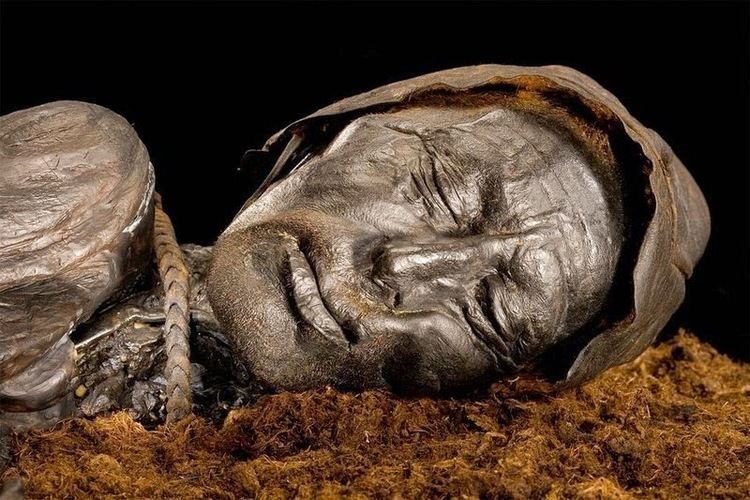
Heaney was also captivated by the liminality of bogs and marshland. Here time lost any real meaning as trees and human bodies would appear untouched, yet from thousands of years ago, preserved in the peat. Both liquid and solid, bogs were a transitionary material full of mystery and menace. He wrote many poems on this. In The Tollund Man, based on the discovery of a mummified human body found in Denmark, 2500 years old, who had still the noose around his neck when he had been hung, he wrote:
"Something of his sad freedom
As he rode the tumbril
Should come to me, driving,
Saying the names
Tollund, Grauballe, Nebelgard,
Watching the pointing hands
Of country people,
Not knowing their tongue.
Out here in Jutland
In the old man-killing parishes
I will feel lost,
Unhappy and at home."
The powerful final lines reflect upon the killing fields of modern conflict in his homeland as he writes "I feel lost, unhappy and at home". These "man-killing parishes" existed in the past and in the present.
Tollund man, found in Denmark. Image from Museum Silkeborg.